What is the impact of laminate flooring on health?
I. Core Components and Potential Risk Sources of Laminate Flooring
To understand its health effects, it is first necessary to understand its "anatomical structure". Standard laminate flooring is typically composed of four layers (sometimes more) of materials combined under high temperature and high pressure:
Wear Layer: The topmost layer, usually a transparent Aluminium Oxide coating. This layer is mainly responsible for scratch resistance and wear resistance. From a health perspective, this layer is highly inert and stable. Once solidified, it poses almost no health risks. It is a physical protective layer rather than a source of chemical emissions.
Decorative Layer: A layer of paper printed with high-definition wood grain or stone grain patterns. This sheet of paper will use ink during the printing process, and some inks may contain heavy metals (such as lead and cadmium, which are strictly restricted in modern compliant products) or other chemicals. However, in formal manufacturing, this layer is sealed between the wear-resistant layer and the core layer, and its potential chemical substances are difficult to be released into the air.
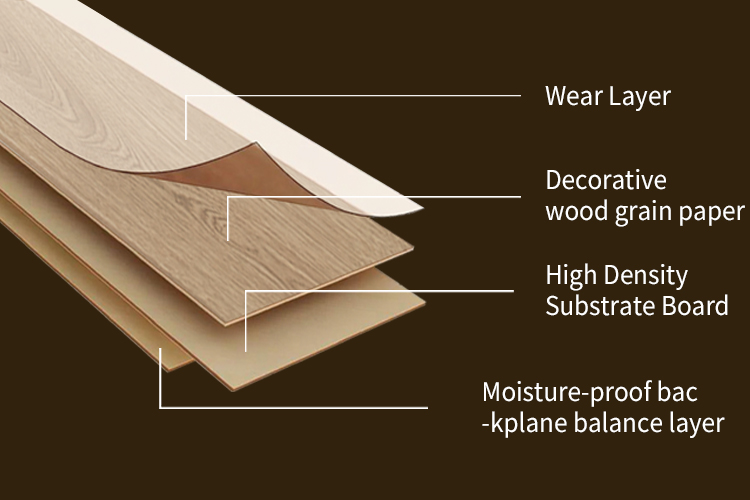
Core Layer: This is the "body" of laminate flooring and the absolute focus of health controversies. Traditionally, the core layer is made of high-density fiberboard (HDF). HDF is made by mixing wood fibers, sawdust, sawdust and other wood residues with synthetic resin adhesives and then pressing them under high temperature and high pressure.
The culprit: urea-formaldehyde resin (Urea-Formaldehyde, UF) : To cut costs, many manufacturers, especially those in the past or with lower standards, use urea-formaldehyde resin as the adhesive for HDF. The advantages of UF resin are its low price and high bonding strength. But its fatal flaw is that it continuously and slowly releases Formaldehyde (Formaldehyde). This release process is called "Off-gassing" and can continue for months or even years after the product is installed.
The health risks of formaldehyde:The World Health Organization (WHO) and the International Agency for Research on Cancer (IARC) have classified formaldehyde as a Group 1 carcinogen, which is a substance that is clearly carcinogenic to humans. Short-term exposure to high concentrations of formaldehyde can irritate the eyes, nose and throat, causing coughing, wheezing, nausea and skin allergies. Long-term exposure is associated with an increased risk of nasopharyngeal cancer and leukemia. Children, the elderly and patients with respiratory diseases are particularly sensitive to it.
Backing Layer: The bottom layer, usually a layer of paper or coating impregnated with resin, is used to balance the floor structure and prevent warping caused by moisture. Similarly, the resin used in this layer may also be a potential source of formaldehyde or other chemicals.
Summarize the core risk points: The most significant health risks of Laminate flooring are almost all concentrated on the formaldehyde-containing adhesives used in its core layer HDF boards. The continuous release of formaldehyde is the core indicator for assessing its "unhealthiness".
Ii. Scientific Analysis and Disputes on Key Health Issues
Apart from the core issue of formaldehyde, there are several other aspects that need to be considered
1. Volatile Organic Compounds (VOCs)
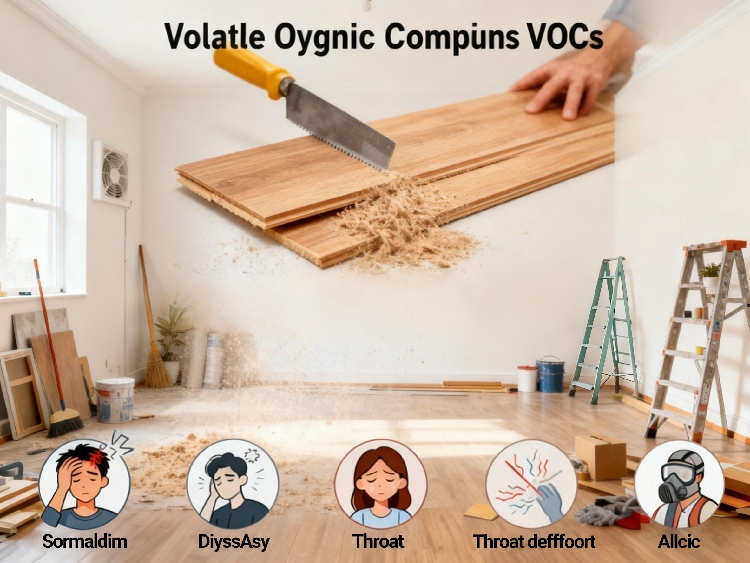
Formaldehyde is the most well-known and strictly regulated type among VOCs, but it is not the only one. During the production process of flooring, other adhesives, coatings and sealants may also be used, all of which may release other VOCs, such as benzene, toluene, xylene, ethylbenzene, etc. These substances together form the "newly renovated smell" of the newly installed floor. Short-term exposure may cause headaches, dizziness, throat discomfort and allergic reactions. However, compared with formaldehyde, these VOCs are usually more volatile. Under well-ventilated conditions, their concentrations will drop rapidly within a few weeks after installation.
2. Phthalates
In the manufacturing of laminate flooring, the use of phthalates is not as widespread as in PVC vinyl flooring (LVT). They are mainly likely to exist in underlayments or certain backboard materials, used as plasticizers. Phthalates are endocrine disruptors and are associated with reproductive and developmental problems. But as for laminate flooring itself, this is not a widespread major risk.
3. Dust and respiratory tract irritation
During the installation process, cutting laminate flooring (especially the HDF core layer) will generate a large amount of fine wood dust. These dusts may irritate the respiratory tract. For installation workers, long-term exposure is an occupational health issue and they must wear appropriate respiratory protective equipment. For residents, thorough cleaning after installation can eliminate this risk.
Iii. International Regulatory Standards and Certifications: The Baseline for Safety
The health risks of laminate flooring in foreign markets (especially in Europe and America) are mainly controlled through strict certification standards and regulations.
The California Air Resources Board (CARB) : California, USA, has long been a leader in global formaldehyde emission standards. CARB ATCM (Air Toxic Control Measures) is divided into two stages, P1 and P2. Among them, CARB ATCM P2 is one of the strictest standards at present, requiring the formaldehyde emission rate of laminate flooring to be less than 0.05 ppm (or a test value of approximately 0.05 mg/m³).
The United States Environmental Protection Agency (EPA) : On the basis of CARB, the federal level of the United States has also introduced the "Formaldehyde Standards Act", whose limits are similar to those of CARB P2 and are enforced nationwide.
European Standard (EN) : The European Union tests the formaldehyde emission through EN 717-1 and adopts the E-class rating system. Among them:
Grade E1: Formaldehyde emission ≤ 0.124mg /m³. This is the entry threshold for the EU market and a mandatory standard.
E0 grade: It is not an official EU standard, but is often used by manufacturers to indicate a lower release than E1 (typically ≤ 0.05mg /m³), similar to CARB P2.
CARB NAF (No aldehyde added) : This is currently the highest standard worldwide. Products that have obtained this certification mean that no formaldehyde-based resin adhesives have been artificially added during the production process of their core base materials. They usually use alternative adhesives, such as polyurethane resin or soy-based bio-glue.
Greenguard/Greenguard Gold Certification: This is an independent third-party certification that not only tests formaldehyde but also the emissions of total volatile organic compounds (TVOC) and many other chemical substances. Greenguard Gold (formerly known as Greenguard Children & Schools) is a stricter standard specifically designed for sensitive groups such as children and the elderly, ensuring that the indoor air quality remains at a high level when the product is used in simulated environments such as schools or kindergartens.
The conclusion is: In the European and American markets, a legally sold laminate floor that meets the above high standards (such as CARB P2, CARB NAF, Greenguard Gold) has a controllable impact on indoor air quality during use, and the risk is relatively low.
Iv. How to Choose Healthier Laminate Flooring and Measures to Reduce Risks
How unhealthy is Laminate flooring? The answer to this question largely depends on what product you choose and how you install and use it.
Purchase suggestions
1.Search for certification marks: Give priority to products with CARB NAF (Best), CARB ATCM P2, and Greenguard Gold certifications. These labels are the most powerful proof of the product's low emissions.
2.Inquire about the type of adhesive: Directly consult the seller or manufacturer about what kind of adhesive is used for the core layer HDF. NAF (No Added Formaldehyde) or products using polyurethane resin (MDI) are safer options.
3.View product documentation: Request and review the Material Safety Data Sheet (MSDS) or Health Product Declaration (HPD) of the product. These documents will detail the potential harmful chemicals contained in the product.
4.Trust well-known brands: Generally, large well-known brands have more ability and motivation to comply with international environmental protection standards, and their quality control and supply chain management are stricter.
5."Smelling" is not an absolutely reliable method: the absence of odor does not mean there is no formaldehyde, as formaldehyde may not be easily detected by the sense of smell at low concentrations. Conversely, if there is an odor, it might just be VOCs, which will dissipate after ventilation. Rely on authentication rather than smell.
Installation and usage suggestions:
1.Adequate ventilation: This is the most effective and economical method. Within a few days to several weeks after installation, keep the indoor Windows wide open and use fans to enhance air circulation to accelerate the dissipation of VOCs and formaldehyde.
2.Control indoor temperature and humidity: The release rate of formaldehyde increases sharply with the rise of temperature and humidity. Maintaining the indoor temperature at a moderate level (such as 22-25°C) and keeping the humidity at 40%-60% with air conditioners and dehumidifiers can significantly reduce the release rate of formaldehyde.
3.Using an air purifier: Choosing an air purifier with activated carbon (for VOCs and formaldehyde) and HEPA (for particulate matter) filters can help adsorb released formaldehyde and other pollutants in the air.
4.Choose high-quality floor MATS: Ensure that the floor MATS used themselves also have low-VOC emission certification to avoid introducing new pollution sources.
V. Conclusion: How unhealthy is Laminate Flooring exactly?
Based on the above analysis, we can draw a hierarchical conclusion:
For old or inferior products that do not meet high standards: The risk is relatively high. Especially those products that use a large amount of urea-formaldehyde resin and have no authoritative low-formaldehyde certification can be regarded as "unhealthy". They will continuously release high concentrations of formaldehyde. Living in such an environment for a long time poses a real threat to respiratory health and increases the risk of cancer.
For qualified products that meet modern international high standards (such as CARB P2, E1) : The risk is low and within an acceptable range. For healthy adults, under normal ventilation conditions, the health risks posed by this type of flooring are minimal. It is not a "highly toxic" product, but rather an option among modern industrial products where risks are strictly controlled.
For high-end products that have obtained top-level certifications (such as CARB NAF, Greenguard Gold) : The risk is extremely low. This type of product can be regarded as "healthy and safe". Their formaldehyde emission is close to that of natural wood, and the emissions of other VOCs are also controlled at an extremely low level. Even for baby rooms, children's bedrooms or rooms for asthma patients, they can be used with confidence after adequate ventilation.

Final conclusion:
It is unfair to uniformly label laminate flooring as "unhealthy", but it is even more dangerous to ignore the potential risks brought by its core material (containing aldehyde HDF). Its "healthiness" is a spectrum rather than an absolute matter of right and wrong.
In today's market, technological advancements and strict regulation have provided consumers with a large number of safe options. The key issue lies in "Is Laminate flooring healthy?" How do I choose a healthy laminate flooring and use it safely? . By becoming an informed consumer, proactively seeking authoritative certifications, and taking the correct post-installation treatment measures, you can fully enjoy the economic and practical benefits brought by laminate flooring without overly sacrificing the indoor air quality and health of you and your family.